The Great Migration Explained: When, Where and Why
GetTripGo Travel Desk · 8 min read
Every year, roughly two million wildebeest, zebra, and gazelle move in a rough circle between Tanzania's Serengeti and Kenya's Masai Mara, chasing rain and fresh grass. It's the largest overland migration of large mammals left on Earth, and it doesn't follow a fixed calendar — it follows the weather.
Quick Answer
- Best months for Mara River crossings: July through September.
- Best months for calving: January through March, southern Serengeti.
- Where the herds are right now: depends on rainfall — exact dates shift 2–4 weeks year to year.
When Does the Migration Happen?
The herds spend January through March calving on the southern Serengeti plains, where nutrient-rich grass supports nursing mothers — around 500,000 calves are born within a few weeks each year. By April and May, as the plains dry out, the herds start moving northwest through the central Serengeti. June brings them toward the western corridor, where they cross the Grumeti River. By July, the front of the migration typically reaches the Mara River, the border between Tanzania and Kenya, and pushes into the Masai Mara through August and September. October and November see the herds drift back south as the short rains return, closing the loop by December.
These dates shift by two to four weeks most years depending on rainfall, so "the migration" isn't a single event you can pin to a date on a calendar — it's a slow-moving wave that a good local guide tracks in near real time. For a full season-by-season breakdown of Kenya's weather patterns, see our guide to the best time to visit Kenya.
Why Do They Migrate?
The migration isn't a fixed instinctive route so much as a constant response to rainfall and grass quality. Wildebeest need short, nutrient-dense grass, and they follow storm systems that trigger new growth, which is why the timing shifts from year to year rather than running on a strict calendar. Researchers tracking collared animals have found the herds can sense rainfall from many kilometers away, likely through a combination of smell, distant lightning, and visual cues like darkening skies on the horizon.
Zebra and gazelle travel alongside the wildebeest but for slightly different reasons — zebra eat the taller, coarser grass first, effectively clearing the way for wildebeest to reach the shorter grass underneath, while gazelle follow behind picking off the shortest regrowth. This layered grazing pattern is part of why the three species move together rather than competing directly for the same food.
The River Crossings
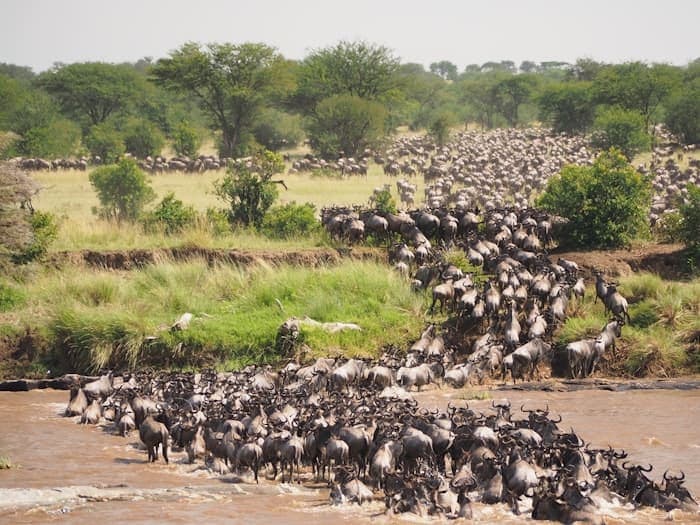
The most dramatic moments — and the ones most photographed — are the river crossings, particularly at the Mara River. Herds gather in their thousands on one bank, hesitate, and then surge across water that often holds large crocodiles. Crossings aren't scheduled; a herd might approach a crossing point three times in a day before committing, or not cross at all if the water looks wrong to them. Camps near the Mara River in the Masai Mara give you the best odds of catching one between July and September, but patience — sometimes days of it — is part of the deal.
Positioning matters more than most people realize. Popular crossing points get crowded with vehicles during peak months, and a guide who knows which bend in the river the herds are currently favoring — rather than parking at the most famous spot and waiting — usually gets you a clearer, less obstructed view.
Where to Base Yourself
- January–March: Southern Serengeti (Ndutu area) for calving season
- April–May: Central Serengeti, as herds start moving
- June–July: Western Serengeti, Grumeti River crossings
- July–October: Masai Mara, Kenya, for Mara River crossings
- November–December: Southern Serengeti again, as the herds return
If you only have one trip in you and want the classic river-crossing shot, July through September in the Masai Mara is the safest bet, though also the busiest and most expensive stretch of the year. Wildlife density in the Mara during these months also makes it one of the more reliable windows for seeing the Big Five in the same trip.
Photographing the Migration
Early morning light between roughly 6:30 and 8:30am produces the strongest images — low, warm sun and dust kicked up by moving herds. A telephoto lens in the 200–400mm range covers most action shots, while a wider lens helps capture the scale of a large herd or a crossing in full swing. At river crossings specifically, position matters: a slightly elevated vantage point on the near bank, rather than being level with the water, tends to produce cleaner shots without other vehicles cluttering the frame.
Patience is the real skill. Many photographers wait two to four hours at a single crossing point without a guaranteed payoff, so budgeting multiple mornings for a real attempt — rather than expecting one drive to deliver — sets more realistic expectations than most trip itineraries suggest.
What People Get Wrong
The biggest misconception is that the migration is a single herd moving as one unit. In reality it's broken into many smaller groups spread across a wide area, which is why "is the migration here right now" is really a question about which specific stretch of river or plain you're asking about — not the whole event. Camps and guides who move seasonally with the herds, rather than staying fixed in one location, tend to give you better access regardless of month.
None of this is guaranteed. Wildlife doesn't read itineraries, and even well-timed trips sometimes miss a crossing by a day. But understanding the rough seasonal pattern — where the grass is, where the water is — is what separates a lucky sighting from a planned one.
Frequently Asked Questions
Is the Great Migration guaranteed if I visit in July?
No sighting in nature is guaranteed, but July through September in the Masai Mara is statistically the most reliable window for both the general migration and river crossings specifically.
Can I see the migration in Kenya, or only Tanzania?
Both. The migration is a single circuit spanning both countries — Kenya's Masai Mara hosts the herds roughly July through October, while Tanzania's Serengeti hosts them the rest of the year, including calving season.
How many days do I need to see a river crossing?
Most experienced guides recommend at least three to four days in the Mara during peak season to give yourself a realistic chance, since crossings can't be scheduled on demand.